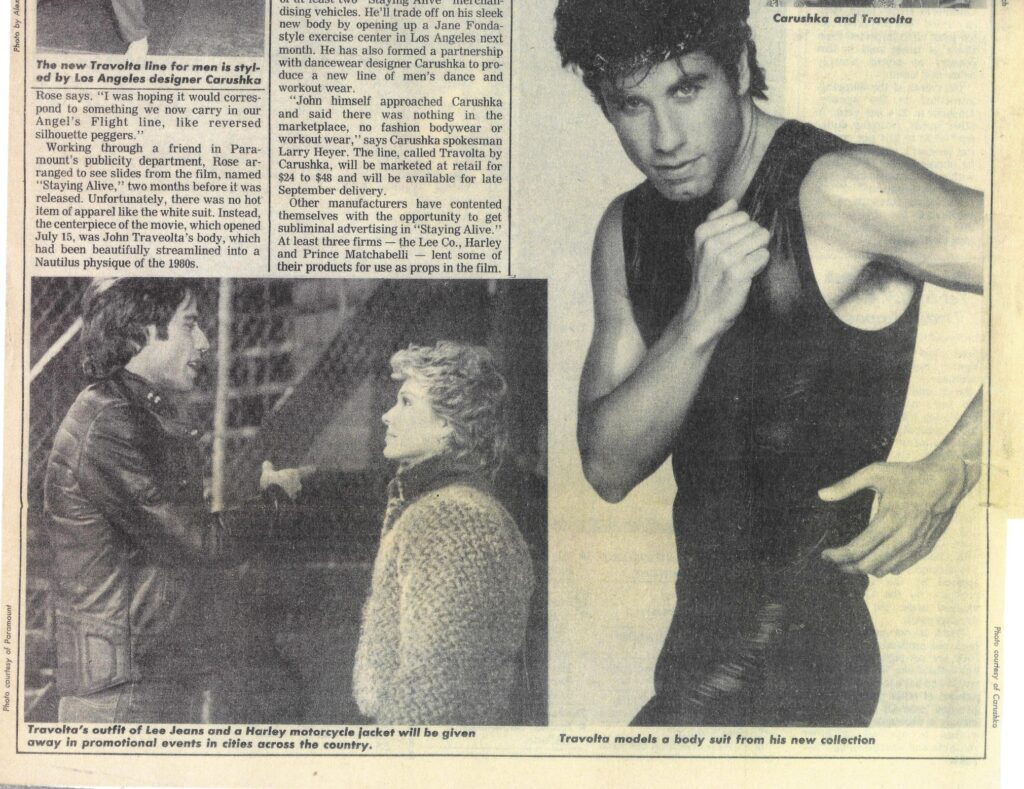
Publication: DNR (Daily News Record) – Vol. 13, No. 142
Date: Tuesday, July 26, 1983
Location: New York, NY (Fairchild Business Newspaper)
Full Text Transcription:
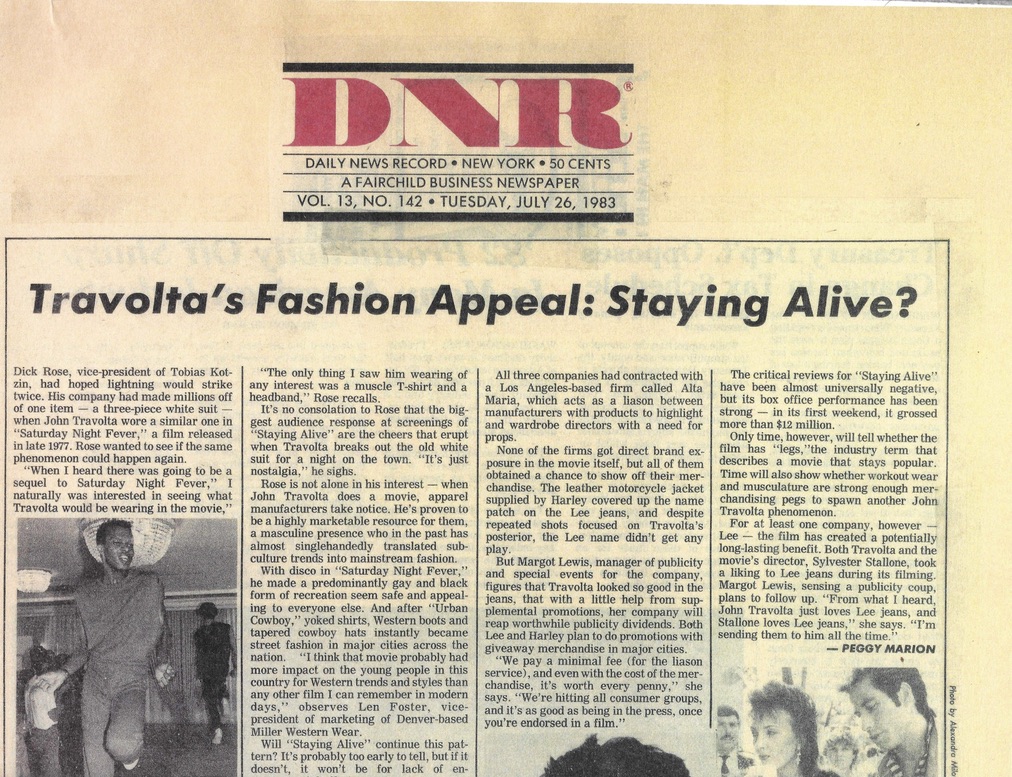
Dick Rose, vice-president of Tobias Kotzin, had hoped lightning would strike twice. His company had made millions off of one item — a three-piece white suit — when John Travolta wore a similar one in “Saturday Night Fever,” a film released in late 1977. Rose wanted to see if the same phenomenon could happen again.
“When I heard there was going to be a sequel to Saturday Night Fever, I naturally was interested in seeing what Travolta would be wearing in the movie,”Rose says, “I was hoping it would correspond to something we now carry in our Angel’s Flight line, like reversed silhouette peggers.”
Working through a friend in Paramount’s publicity department, Rose arranged to see slides from the film, named “Staying Alive,” two months before it was released. Unfortunately, there was no hot item of apparel like the white suit. Instead, the centerpiece of the movie, which opened July 15, was John Travolta’s body, which had been beautifully streamlined into a Nautilus physique of the 1980s.
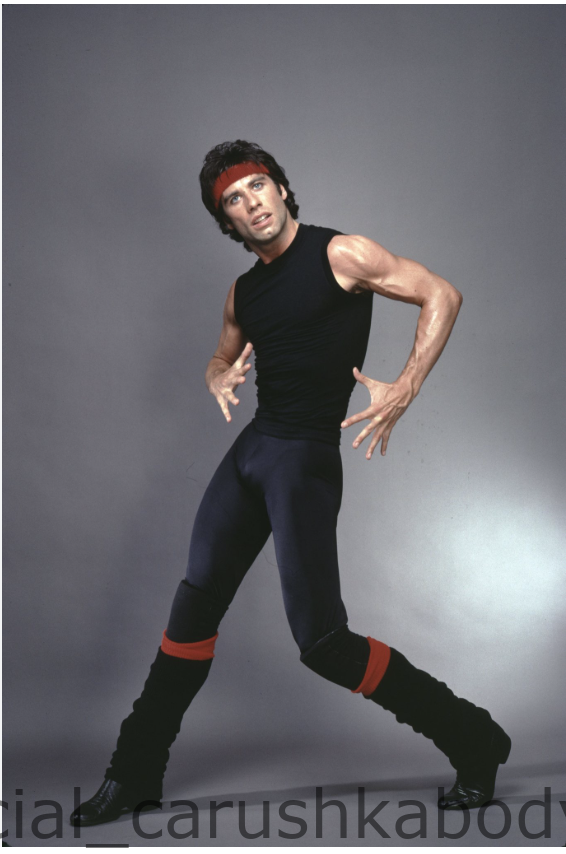
“The only thing I saw him wearing of any interest was a muscle T-shirt and a headband.” Rose recalls.
It’s no consolation to Rose that the biggest audience response at screenings of “Staying Alive” are the cheers that erupt when Travolta breaks out the old white suit for a night on the town. “It’s just nostalgia,” he sighs.
Rose is not alone in his interest — when John Travolta does a movie, apparel manufacturers take notice. He’s proven to be a highly marketable resource for them, a masculine presence who in the past has almost singlehandedly translated sub-culture trends into mainstream fashion.
With disco in “Saturday Night Fever,” he made a predominantly gay and black form of recreation seem safe and appealing to everyone else. And after “Urban Cowboy,” yoked shirts, Western boots and tapered cowboy hats instantly became street fashion in major cities across the nation. “I think that movie probably had more impact on the young people in this country for Western trends and styles than any other film I can remember in modern days,” observes Len Foster, vice-president of marketing of Denver-based Miller Western Wear.
Will “Staying Alive” continue this pattern? It’s probably too early to tell, but if it doesn’t, it won’t be for lack of enthusiasm and staying alive merchant vehicles.
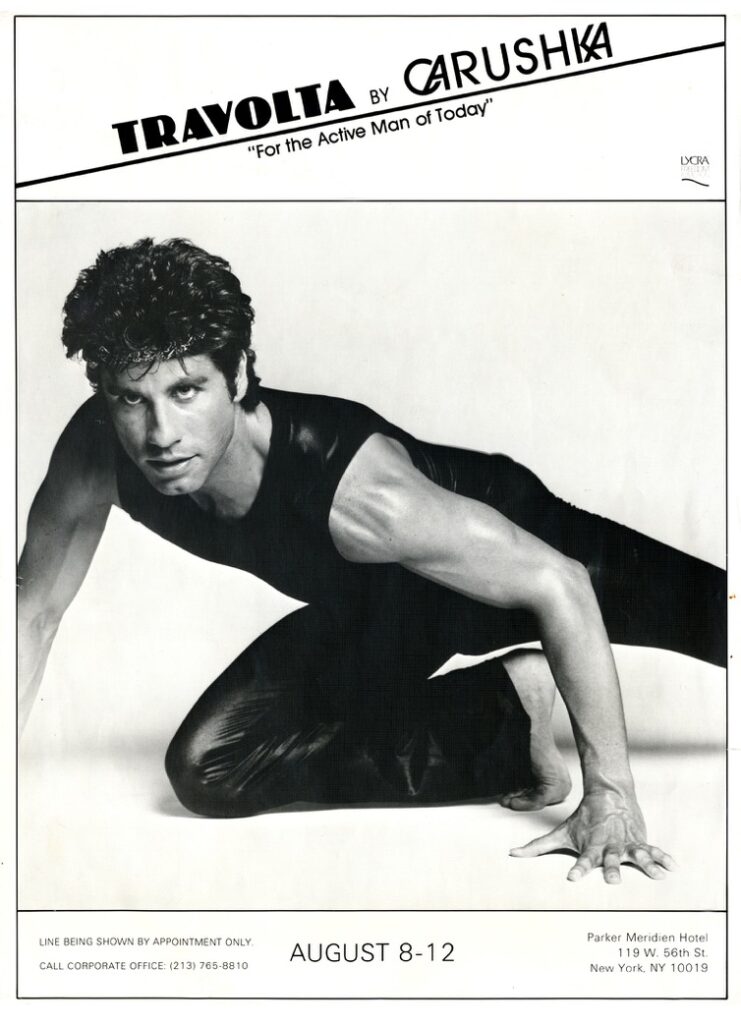
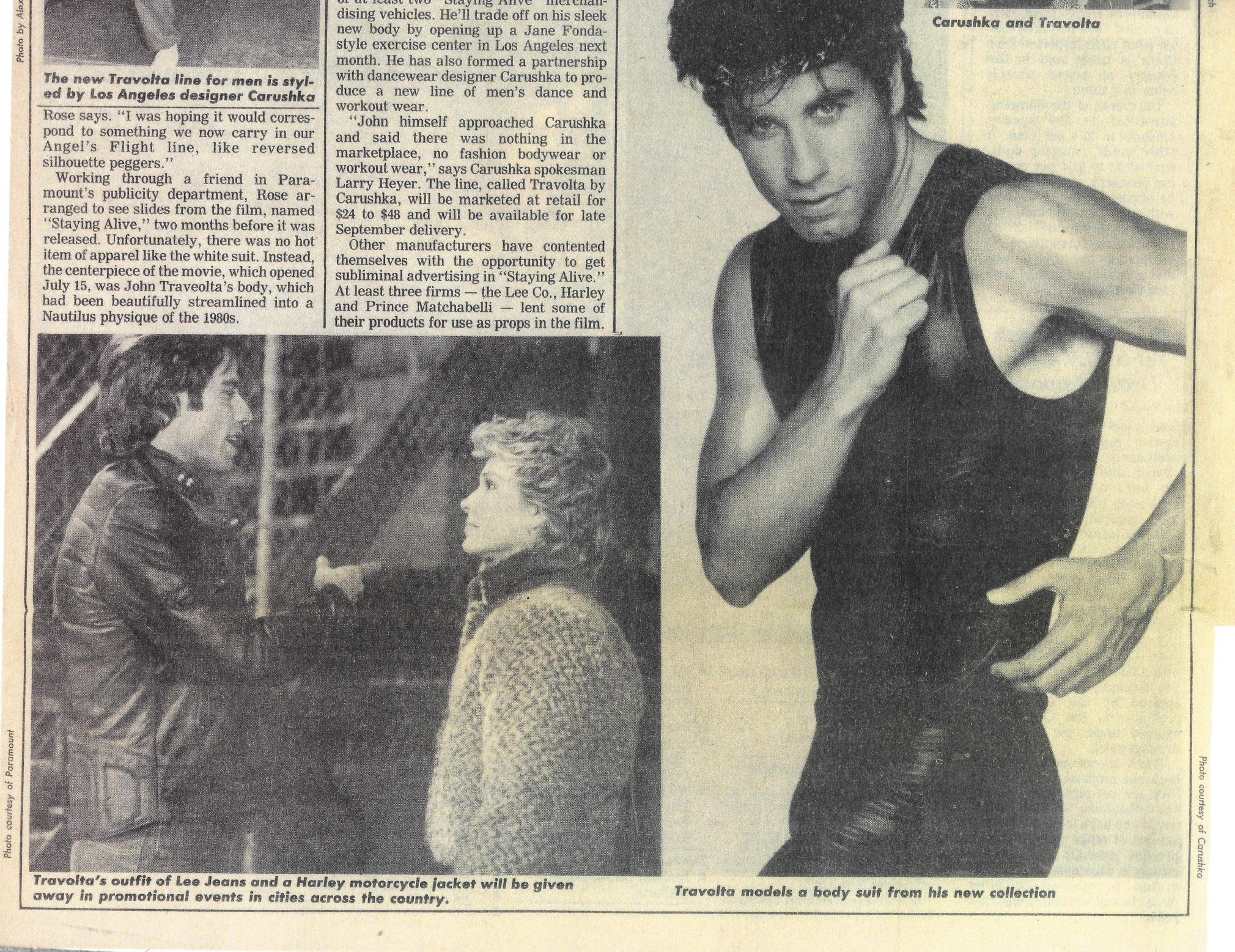
He’ll trade off on his sleek new body by opening up a June Fonda-style exercise center in Los Angeles next month. He has also formed a partnership with dancewear designer Carushka to produce a new line of men’s dance and workout wear.
“John himself approached Carushka and said there was nothing in the marketplace, no fashion bodywear or workout wear,” says Carushka spokesman Larry Heyer. The line, called Travolta by Carushka, will be marketed at retail for $24 to $48 and will be available for late September delivery.
Other manufacturers have contented themselves with the opportunity to get subliminal advertising in “Staying Alive.” At least three firms — the Lee Co., Harley and Prince Matchabelli — lent some of their products for use as props in the film.
All three companies had contracted with a Los Angeles-based firm called Alta Maria, which acts as a liaison between manufacturers with products to highlight and wardrobe directors with a need for props.
None of the firms got direct brand exposure in the movie itself, but all of them obtained a chance to show off their merchandise. The leather motorcycle jacket supplied by Harley covered up the name patch on the Lee jeans, and despite repeated shots focused on Travolta’s posterior, the Lee name didn’t get any play.
But Margot Lewis, manager of publicity and special events for the company, figures that Travolta looked so good in the jeans, that with a little help from supplemental promotions, her company will reap worthwhile publicity dividends. Both Lee and Harley plan to do promotions with giveaway merchandise in major cities.
“We pay a minimal fee (for the liaison service), and even with the cost of the merchandise, it’s worth every penny,” she says. “We’re hitting all consumer groups, and it’s as good as being in the press, once you’re endorsed in a film.”
The critical reviews have been almost universally negative, but its box office performance has been strong — in its first 10 days, it pulled in more than $12 million.
Only time, however, will show if the film has “legs,” the term the trade uses to describe a movie with staying power. Time will also show whether Travolta’s brand and musculature are effective merchandising pegs to hang a film on. The Travolta phenomenon continues to build.
For at least one company — H.D. Lee — the film has already provided a long-lasting benefit. According to the movie’s director, Sylvester Stallone took a liking to Lee jeans during its filming. Margot Lewis, sensing a publicity coup, plans to follow up. “From what I heard, John Travolta just loves Lee jeans, and Stallone loves Lee jeans,” she says. I’m sending them to him all the time.”
–PEGGY MARION
Travolta by Carushka Ad: